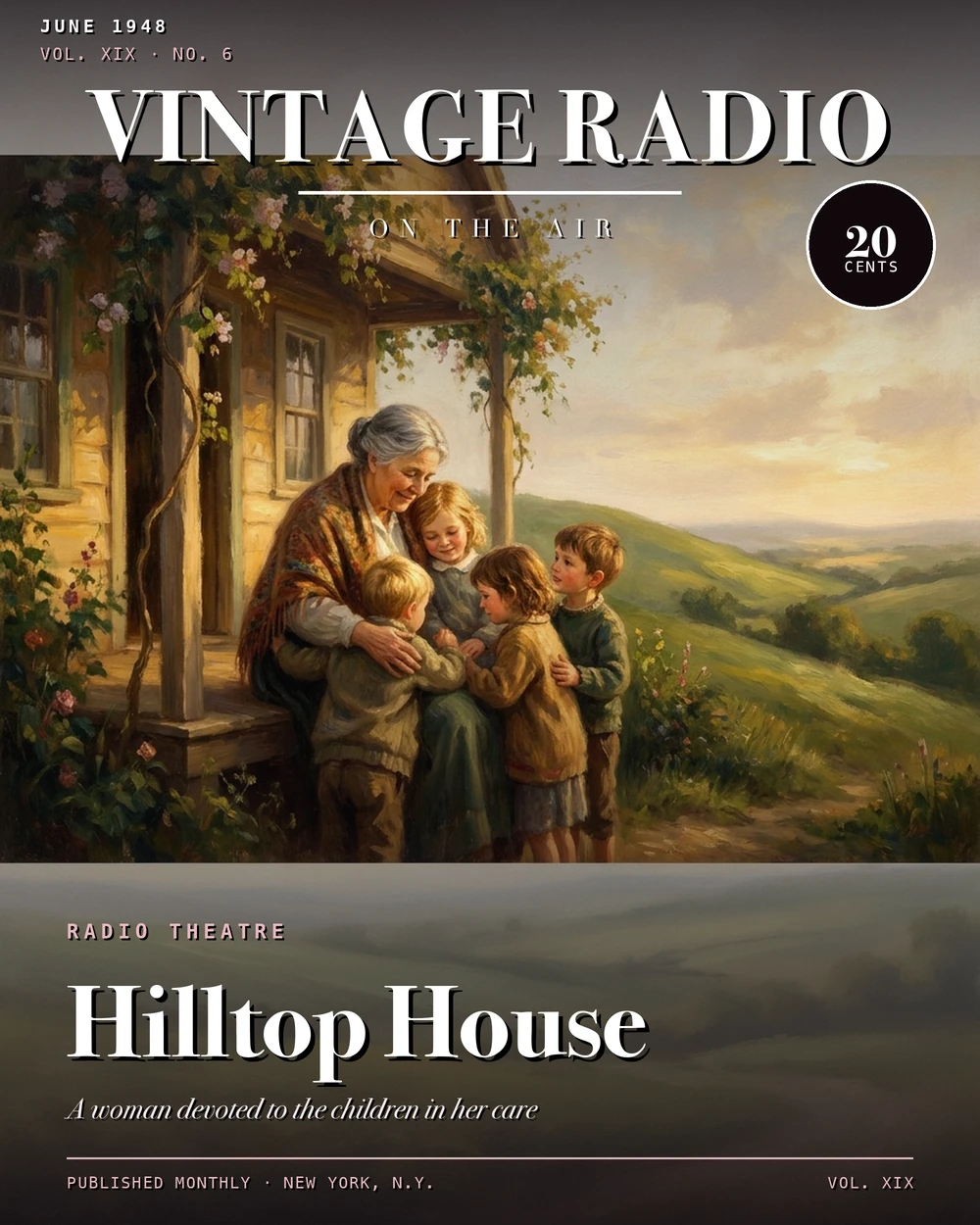
Hilltop House
A Soap Opera Built Around One Actress
What made Hilltop House unusual from the start was the decision to name the fictional heroine after the real actress playing her. When the show launched on CBS on November 1, 1937, the lead character was called Bess Johnson — and so was the woman performing the role. That wasn't laziness or a coincidence; it was a deliberate calculation by the producers. Bess Johnson had spent six years playing Lady Esther in commercials during Wayne King's band broadcasts, and her name had become familiar enough to listeners that attaching it to the show's central character was a genuine draw. She was described in the trade press as "the highest paid daytime radio artist," and Palmolive Hilltop House — as it was informally known, after its sponsor — was Palmolive Soap's first entry into daytime radio drama.
The premise placed this character at the center of a small-town orphanage called Hilltop House, in Glendale. Bess Johnson the character was a dedicated caseworker who spent her days managing the youngsters in her care, navigating financial pressures, and dealing with conflicts between the staff and the orphanage's board of directors. The show opened with an epigraph that aired regularly: "Hilltop House is dedicated to the women of America … the story of a woman who must choose between love and the career of raising other women's children." That framing — domestic vocation versus romantic possibility — was standard soap territory, but the execution set the show apart. A review in Radio Daily the morning after the premiere called the script and writing "well above the average serial."
Stories typically followed the youngsters' interactions with adults alongside the orphanage's running money troubles and the friction between staff and the board. The supporting cast was deep: Carleton Young and Spencer Bentley alternated as Dr. Robby Clark, the town physician and a friend of Bess; Alfred Swenson and Jack Roseleigh shared the role of Paul Hutchinson, the town banker; Irene Hubbard played Bess's backbiting assistant Thelma Gidley; Jimmy Donnelly and Janice Gilbert played the orphans Jerry and Jean Adair; and John Moore and David Gothard rounded out the regular company as David Barton and Captain John Barry. Carlo De Angelo and Jack Rubin directed.
The Woman Behind the Character
The real Bess Johnson was born February 22, 1901, in Keyser, West Virginia, and grew up in Elkins in a family steeped in entertainment and public life. Her father owned two theaters, ran a newspaper, and served as a state senator; her mother, Ann Barnes, was an actress. Johnson had originally planned a singing career, but a tonsillectomy left her unable to sing, and she turned to drama. She studied at Carnegie Tech in Pittsburgh and then at the American Academy of Dramatic Arts in New York City, working her way through school as an artists' model and a restaurant worker.
Her radio career started around 1929–1930, and by 1933 she was playing Frances Moran Matthews on the NBC soap Today's Children, a role she held until 1937. The six years voicing Lady Esther in the Wayne King broadcasts gave her a kind of celebrity that crossed program boundaries — listeners recognized the name before they recognized any character attached to it. That popularity is what made the naming decision on Hilltop House make commercial sense. A 1948 article in Maclean's reported that her salary at the time of the show's first run had been approximately $1,600 a week.
She was married first to Dr. Solomon P. Perry, her childhood sweetheart, with whom she had a daughter named Jane; the couple divorced in November 1936. In June 1941 she married Olympic swimmer Peter Fick. After Hilltop House she moved to television, playing Irene Barron on the CBS soap Search for Tomorrow from 1951 to 1954 and again from 1960 to 1961, turning up on Armstrong Circle Theatre, and hosting a six-month DuMont fashion program called The Bess Johnson Club. She died on January 3, 1975, in New York City.
The 1941 Break and the Spinoff
The first CBS run ended not with a gradual fade but with a conflict. In 1941, Palmolive attempted to cut the show's budget. Producer Ed Wolfe refused to accept the cuts — Radio Spirits later described the resistance as protecting the show's "fine, literate quality" against the new ad agency's demands — and pulled the program off the air rather than compromise it. The following Monday, Bess Johnson moved to NBC with the same character intact, now playing under the title The Story of Bess Johnson.
The on-air explanation was that bigoted officials had dismissed the character from Hilltop House, and the new serial would follow her as she looked for work and faced fresh dramatic complications. In the story, she had become superintendent of a boarding school called Mount Holly School. The Story of Bess Johnson ran on NBC from March 31, 1941, to September 25, 1942, on weekdays at 10 a.m., sponsored by Kleenex. A concurrent CBS broadcast ran from March 31 to June 27, 1941, at 4 p.m. before the show settled on NBC alone.
During that NBC run, First Lady Eleanor Roosevelt made a guest appearance. According to a June 12, 1941, report in The Des Moines Register, the plot had Roosevelt visiting Mount Holly School to address "the complexities now confronting the young women of America." It was the kind of moment that illustrated how seriously the show took its subject matter — and how much cultural capital the Bess Johnson name could still attract.
The Second Life of Hilltop House
After a gap of several years, Hilltop House returned to CBS on May 17, 1948, with a new producer, a new heroine, and a new sponsor in Miles Laboratories, makers of Alka-Seltzer. The original Bess Johnson character was gone. In her place — at first as an assistant to a superintendent named Grace Dolben, and only later as the show's central figure — was Julie Erickson, described in a Maclean's profile from September 1948 as "the attractive young matron of an orphanage whose sympathy and understanding develop confidence, respect and love in the often unruly and unhappy youngsters assigned to her care." The revival was produced in New York, airing weekdays at 3:15 until 1951, then shifting to 3:00. Robert Haag played Dr. Jeff Browning and Phil Sterling played Reed Nixon among the new regulars.
Two actresses shared the role of Julie over the course of this run. Grace Matthews, born September 3, 1910, in Toronto, attended the University of Toronto and trained at London's Royal Academy of Dramatic Art before working in radio in Canada and then the United States. The same Maclean's profile noted that she performed Julie Erickson at 3:15 p.m. each weekday on CBS, coming directly off the lead role of Ruth Wayne on Big Sister at 1:00 p.m. on the same network — a demanding double that was not uncommon for working radio actors of the period. OTR sources list her tenure in the role as approximately 1948 to 1956.
Jan Miner — born Janice Miner on October 15, 1917, in Boston — studied at the Vesper George School of Art before training under Lee Strasberg and making her stage debut in 1945 in a Boston production of Elmer Rice's Street Scene. She eventually succeeded Matthews as Julie Erickson and remained with the show until it ended. The connection to Colgate-Palmolive, which sponsored the revived Hilltop House, is generally cited as a likely factor in Miner being cast decades later as Madge the manicurist in Palmolive dishwashing detergent television commercials — a role she played for 27 years beginning in the 1960s.
Don Hastings, later known to television audiences as Dr. Bob Hughes on As the World Turns, appeared on Hilltop House as part of his radio work during the 1940s and 1950s. Frank Gallop — born June 30, 1900, in Boston, originally a stockbroker who entered radio in 1934 at Boston station WEEI — was the show's announcer, though during the first run it was Bess Johnson herself who presented the Palmolive commercials. Gallop's soap opera work during this era was largely on serials produced by Frank and Anne Hummert, who were responsible for at least 125 radio programs.
The writing team during the original run consisted of Addy Richton and Lynn Stone, who worked under the joint pen name Adelaide Marstone (some secondary sources render it Marston). The show's theme music was Brahms' Lullaby.
How It Ended
The second CBS run continued until July 1, 1955. For its final year on that network the sponsor had changed from Miles Laboratories to Pharmaco, Inc. After a gap of just over a year, the show returned one more time on NBC, running from September 3, 1956, to July 30, 1957, on weekdays mostly at 3:30 in the familiar 15-minute format. That final NBC run faced the twin pressures affecting all daytime radio serials by the mid-1950s: growing television audiences and local stations pulling back from soap opera programming. The show ended quietly on July 30, 1957, twenty years after it had begun.
Radio historian Jim Cox covered the show in both The Great Radio Soap Operas (McFarland, 2015) and his Historical Dictionary of American Radio Soap Operas (Scarecrow Press, 2005), writing that listeners "related to the tenderness with which this tireless servant went about her tasks." Radio Spirits called it "one of the rare daytime dramas to stand out from its weepy brethren," pointing to the consistent quality of its writing as what separated it from the bulk of the serial field. Radio and Television Mirror ran features tied to the show in September 1949 and again in May 1953, suggesting it held a real readership well into its second run. A small number of episodes from the Palmolive era survive, among them a September 21, 1939 broadcast captured as part of a full broadcast day from CBS affiliate WJSV in Washington, D.C.